Pelosi Reflects on World AIDS Day: "The Fight Isn’t Over."
San Francisco – For World AIDS Day, Speaker Emerita Nancy Pelosi reflected with Vogue on her nearly four decades of advocacy in the fight against HIV/AIDS. Pelosi recalled her first moments as a new Member of Congress in 1987, when she declared on the House Floor that she came to fight against HIV/AIDS.
Pelosi highlighted key milestones in that work, including helping to pass the Ryan White Care Act and contributing to the NAMES Project AIDS Memorial Quilt. She noted how dramatically treatment and prevention have advanced since those early years, strengthened by initiatives like PEPFAR and USAID. But she warned that recent funding cuts and rising misinformation threaten to reverse decades of progress.
“On World AIDS Day, we reflect on its devastating toll and honor the beautiful souls stolen by this virus,” Speaker Emerita Pelosi said. “As we continue the fight to banish AIDS to the dustbin of history, we refuse to be deterred by the Administration’s efforts to abandon this life-saving work. We are not going back to an era of stigma, fear and cruelty."
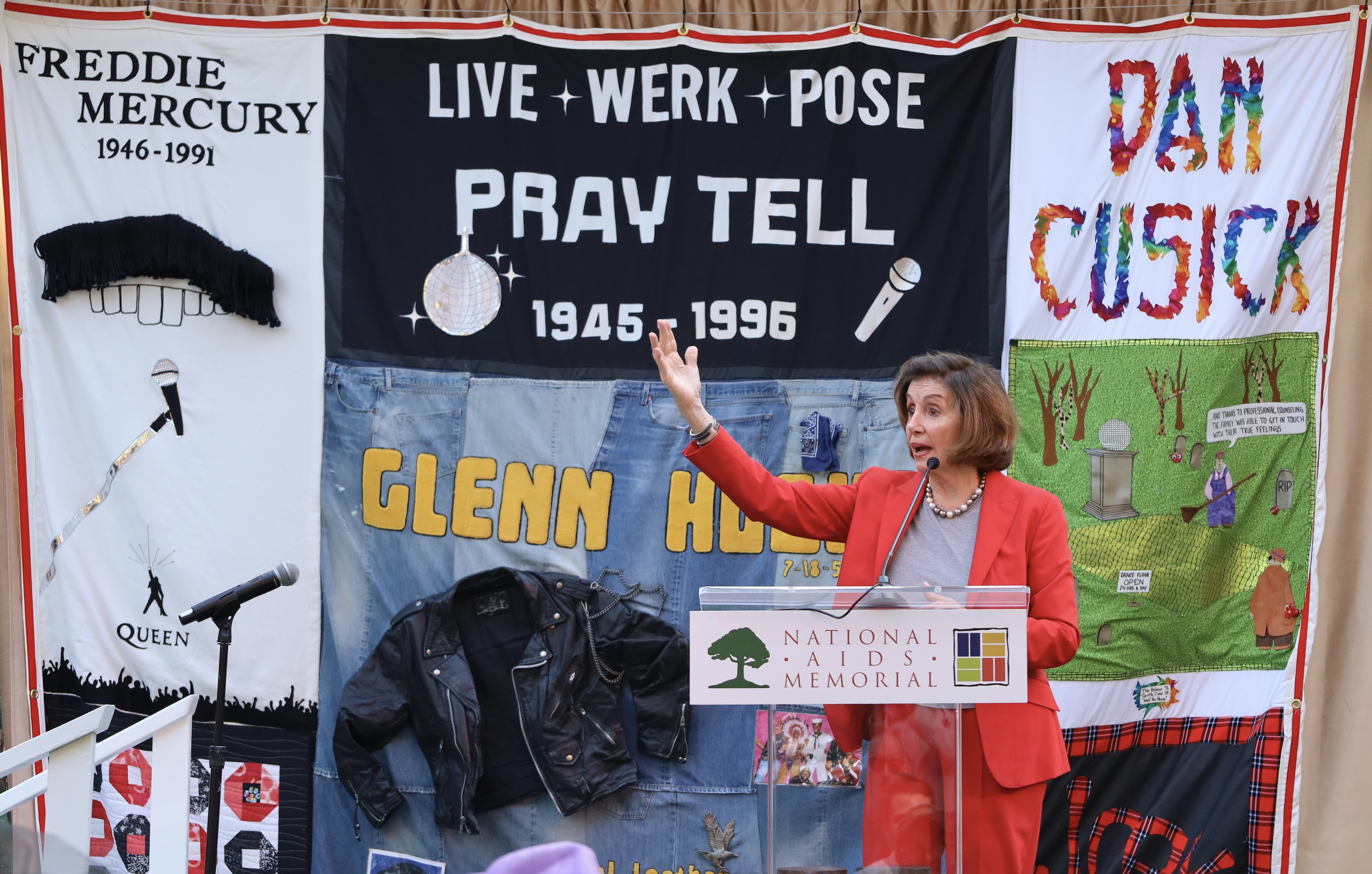
Speaker Emerita Pelosi delivers remarks today during an event marking World AIDS Day hosted by the National AIDS Memorial Grove in San Francisco.
Read the full story below:
Vogue: Nancy Pelosi Reflects on World AIDS Day and Continuing the Fight
[By Margaux Anbouba, 12/1/25]
When Rep. Nancy Pelosi was sworn into Congress on June 2, 1987, she was told to keep her personal statement short.
“Some of the members that I knew said, ‘Nobody wants to hear from a freshman member,’” Pelosi says. She was the only person being sworn in that day, after winning a special election following the death of Rep. Sala Burton. “But after I was sworn in, the Speaker of the House at the time, Jim Wright, asked, ‘Does the gentlelady wish to address the house?’ I didn’t want to say no. I thanked my parents, my constituents who sent me there, and said, ‘Sala sent me and I came to fight against HIV and AIDS.’ Period.”
Pelosi, who announced last month that she will not seek reelection when her term in Congress ends in 2027, has represented San Francisco throughout her career—one of the cities hit hardest by the HIV/AIDS epidemic. It’s estimated that close to 20,000 people died from AIDS in San Francisco during the 1980s and early ’90s, as Pelosi entered elected office.
Her remarks to her peers in Congress lasted less than a minute, but they would set the tone for Pelosi’s work going forward. “AIDS affected everybody we knew at the time,” she tells Vogue during a phone interview. “Largely, it was in the gay community at first. But then it became more and more people. In those days, we were going to a few funerals a week, sometimes two a day. It was a death penalty to have a diagnosis of HIV and AIDS.” In 1990, Pelosi helped to pass the Ryan White Care Act, which remains the largest federal care program for people with HIV/AIDS. She also contributed to the historic NAMES Project AIDS Memorial Quilt, made of hand-sewed panels of fabric commemorating more than 700,000 people who have died from the disease.
When LGBTQ+ rights activist Cleve Jones first came to Pelosi and proposed the quilt project, she thought the idea was crazy. “Nobody sews anymore,” she says. “I’m a mother of five and went to convent school, where they taught me how to knit, crochet, darn, everything. And I didn’t sew!”
But, she admits, she was wrong. The NAMES Project AIDS Memorial Quilt quickly grew into the largest piece of American folk art in the world—and got Pelosi to pick up a needle and thread herself. Pelosi designed and made a square for the flower girl from her wedding, Susie Piracci Roggio. “Susie was a champion for the cause,” Pelosi says. “She used her diagnosis to help prevent other people from dying, [while] actually dying from it at the time.” (Pelosi knows other people memorialized on the quilt, too, including her former aide Scott Douglass, who lost his battle with AIDS at age 34.)
In the 38 years that Pelosi has served this country, the narrative around HIV/AIDS—as well as its course of treatment—has changed dramatically. That has a lot to do with the United States Agency for International Development (USAID) program, as well as the President’s Emergency Plan for AIDS Relief (PEPFAR), the latter of which Pelosi worked with Republican President George W. Bush to create in 2003.
Some of that progress, though, has recently been imperilled. Among the first things President Donald Trump did upon taking office for the second time was to dismantle USAID, and an anti-condom movement has taken root among American 20-somethings.
Pelosi’s message on this is clear: “You don’t want this disease.” The funding cuts, she urges, don’t mean that HIV/AIDS is no longer an issue. UNAIDS anticipates that this discontinuation of AIDS-related education and programming will lead to an additional 6.6 million HIV infections and 4.2 million AIDS-related deaths between now and 2030.
“Young people need to understand that while we have been able to improve the quality of life of those with HIV/AIDS,” Pelosi says, “the fight isn’t over.”