Pelosi Defends Separation of Powers: “The Constitution Should Not Be A Casualty Because You Want To Take A Shortcut To War.”
Washington, D.C. – Ahead of the House vote on the Iran war powers resolution, Speaker Emerita Nancy Pelosi delivered remarks on the House Floor emphasizing the constitutional powers of Congress to authorize war and warning against bypassing the separation of powers amid debate over the initiation of U.S. military hostilities with Iran.
In her remarks, Pelosi expressed mourning for the American servicemembers who have already lost their lives in the conflict and urged Congress to honor their sacrifice by carefully exercising its constitutional duty. She stressed that while Members across the aisle agree Iran must not obtain a nuclear weapon, protecting the Constitution must remain paramount.
Pelosi underscored that the debate before Congress is not about the merits of war itself, but about safeguarding the authority granted to Congress under Article One of the Constitution to declare war.
Watch Pelosi's Floor remarks here.
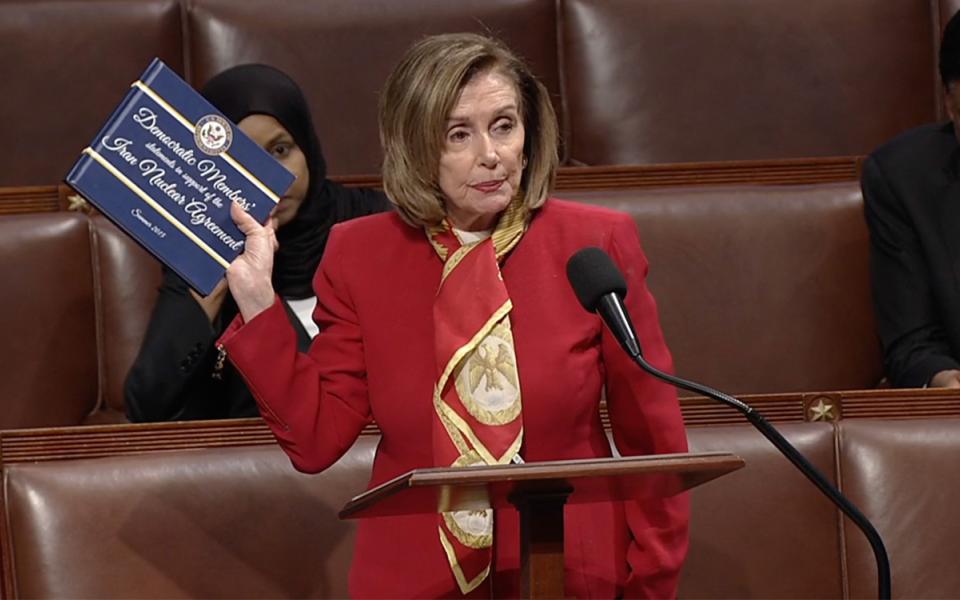
Read the transcript of Speaker Emerita Pelosi's Floor remarks below:
Speaker Emerita Pelosi. Thank you, Mr. Speaker. I thank the gentleman for yielding and for his kind words, but more importantly, for his leadership in bringing us together today in his great statement, and that of our distinguished Leader, Mr. Jeffries, that we heard earlier.
I stand here as former Leader, but also as one with 30 years of experience in Intelligence. And I think this is a very important debate for us to have. There are two debates going on here.
One is the debate as to the Constitution of the United States. The other is whether Iran should have a nuclear weapon, which we all agree they should not. But that doesn’t mean the Constitution of the United States should be a casualty of that because you want to take a shortcut to war.
I rise in mourning for the brave servicemembers who have given their lives in this conflict. We honor their ultimate sacrifice, and we pray for them, their families and all who were injured in it so far.
I had some veterans, Mr. Speaker, in my office earlier today on two different occasions, and we talked about the fact that having six people killed so early at the beginning of a conflict, initiation of hostilities, is unacceptable.
What is our plan? What do we have in mind for them?
So again, we all agree Iran should not have a nuclear weapon. And to that end, I’m proud of what President Obama did with this. He was masterful in diplomacy, in forging an agreement that verifiably prevented Iran from obtaining a nuclear weapon.
I have this book of statements from our colleagues who told the President, we need to see the substance of the agreement. We need to see the validation and proof of it all. We need to get the communication to the American people.
The President respected the Congress and came and gave reasons. And this is for an agreement. And this President won’t even come and give us the data for an action of war.
So let’s be clear. This is not a debate about the merits of the war—that’s another debate. It’s a debate of the Constitution of the United States.
The beauty of the Constitution, central to it, is the separation of powers.
And central to that power is Article One. In that Article One is the power of the Congress to declare war.
So again, let us be serious about our oath of office to protect and defend the Constitution as we protect and defend the people of our country. That is our responsibility. That is what we will do.
I urge our colleagues to vote in support of the Constitution, then go on to the debate of whether we should go into Iran and how we go into Iran. And I think that there will be some mixed views on that.
But that’s a different subject.
I urge our colleagues to honor your oath of office. Honor the vision of our Founders. Honor the sacrifice of our men and women in uniform who've gotten us here today.
Thank you.